<?xml version="1.0" encoding="UTF-8"?>
<?xml-stylesheet type="text/xsl" href="/stylesheets/feed.atom.xml" media="screen"?>
<feed xml:lang="en-US" xmlns="http://www.w3.org/2005/Atom">
  <id>tag:acms.nd.edu,2005:/news</id>
  <link rel="alternate" type="text/html" href="https://acms.nd.edu"/>
  <link rel="self" type="application/atom+xml" href="https://acms.nd.edu/news.atom"/>
  <id>tag:acms.nd.edu,2005:/latest</id>
  <title>Department of Applied and Computational Mathematics and Statistics | News</title>
  <updated>2026-09-30T10:07:22-04:00</updated>
  <link rel="alternate" type="text/html" href="https://acms.nd.edu/"/>
  <link rel="self" type="application/atom+xml" href="https://acms.nd.edu//news.atom"/>
  <subtitle>The Department of Applied and Computational Mathematics and Statistics is focused on tackling complex problems by combining the tools of its field with realistic knowledge of the problem.</subtitle>
  <entry>
    <id>tag:acms.nd.edu,2005:News/185877</id>
    <published>2026-09-30T10:07:22-04:00</published>
    <updated>2026-09-30T10:07:22-04:00</updated>
    <link rel="alternate" type="text/html" href="https://acms.nd.edu/news/notre-dame-hosts-sciml-nd26/"/>
    <title>Notre Dame hosts SciML@ND26</title>
    <summary type="text">
      <![CDATA[On September 26-27, 2026, the University of Notre Dame hosted SciML@ND26, a two-day workshop on Scientific Machine Learning: heory, Algorithms, Applications, and Agentic AI Workflows, held in Jordan Hall of Science. This was the second workshop in the series, following the inaugural edition at Purdue…]]>
    </summary>
    <content type="html">
      <![CDATA[<p>On September 26-27, 2026, the University of Notre Dame hosted SciML@ND26, a two-day workshop on Scientific Machine Learning: heory, Algorithms, Applications, and Agentic AI Workflows, held in Jordan Hall of Science. This was the second workshop in the series, following the inaugural edition at Purdue University in 2025. The full program is available at <a href="http://sciml26nd.github.io/" target="_blank" data-saferedirecturl="https://www.google.com/url?q=http://sciml26nd.github.io&amp;source=gmail&amp;ust=1790863202978000&amp;usg=AOvVaw3gF_2jMfQilOXdJ1Y7O-kk" rel="noopener">sciml26nd.github.io</a>.<br><br>The workshop drew more than 170 registered participants. The program featured 36 invited talks, organized into twelve thematic sessions across two parallel tracks, delivered by speakers from more than twenty universities, three national laboratories (Pacific Northwest, Sandia, and Los Alamos), research institutes, and industry. Topics spanned the mathematical foundations of machine learning; operator learning and learning-enhanced numerical methods for partial differential equations; digital twins and data-driven modeling of dynamical systems; uncertainty quantification and multi-fidelity methods; stochastic analysis and optimal transport; and the emerging use of AI agents and foundation models in scientific discovery.<br><br>Students and early-career researchers contributed 11 lightning talks and 34 posters, presented at a Saturday evening poster session and speakers' banquet. Many of the attendees and poster presenters were Notre Dame students and trainees, and their participation highlighted both the strong interest in machine learning and AI across campus and the breadth of research programs in these areas at Notre Dame.<br><br>The workshop was organized by Zecheng Zhang, Guosheng Fu, Daniele Schiavazzi, and Zhiliang Xu (University of Notre Dame), together with Guang Lin and Di Qi (Purdue University), and was supported by the National Science Foundation (Grant No. 2615564, Computational Mathematics Program). Additional support was generously provided by several units at the University of Notre Dame: the Scientific AI Initiative, the Data, AI, and Computing Initiative, the Colleges of Science and Engineering, Notre Dame Research, the Department of Applied and Computational Mathematics and Statistics, and the Graduate School.</p>]]>
    </content>
    <link rel="enclosure" type="image/webp" href="https://acms.nd.edu/assets/680645/screenshot_2026_09_30_at_100419_am.webp" title="SciML 2026 participants"/>
    <author>
      <name>Daniele Schiavazzi</name>
    </author>
  </entry>
  <entry>
    <id>tag:acms.nd.edu,2005:News/182640</id>
    <published>2026-06-19T12:15:00-04:00</published>
    <updated>2026-06-19T12:15:46-04:00</updated>
    <link rel="alternate" type="text/html" href="https://acms.nd.edu/news/ph-d-student-guanhao-zhou-receives-icsa-student-paper-award/"/>
    <title>Ph.D. Student Guanhao Zhou Receives ICSA Student Paper Award</title>
    <summary type="text">
      <![CDATA[The Department of Applied and Computational Mathematics and Statistics (ACMS) is pleased to congratulate Ph.D. student Guanhao Zhou on receiving a 2026 ICSA Student Paper Award from the International Chinese Statistical Association (ICSA) at the 2026 ICSA Applied Statistics Symposium. Zhou,…]]>
    </summary>
    <content type="html">
      <![CDATA[<p>The Department of Applied and Computational Mathematics and Statistics (ACMS) is pleased to congratulate Ph.D. student Guanhao Zhou on receiving a 2026 ICSA Student Paper Award from the International Chinese Statistical Association (ICSA) at the 2026 ICSA Applied Statistics Symposium.</p>
<p>Zhou, who conducts research in statistics and machine learning, received the award for his paper, “Covariate-Adjusted Deep Causal Learning for Heterogeneous Panel Data Models,” which was recognized among the symposium’s top student research contributions. This paper was co-authored by ACMS Assistant Professors Dr. Yuefeng Han and Zhou's advisor Dr. Xiufan Yu. The award highlights the quality of doctoral scholarship within the ACMS graduate program.</p>
<p>The International Chinese Statistical Association is one of the leading professional organizations promoting research and education in statistics and data science worldwide. The annual ICSA Applied Statistics Symposium brings together researchers from academia, industry, and government to share advances in statistical methodology and applications.</p>
<p>For the complete list of award recipients, visit the 2026 ICSA Applied Statistics Symposium awards announcement: <a href="https://symposium2026.icsa.org/icsa-symposium-awards/" target="_blank" data-saferedirecturl="https://www.google.com/url?q=https://symposium2026.icsa.org/icsa-symposium-awards/&amp;source=gmail&amp;ust=1781961622554000&amp;usg=AOvVaw2264GkPnTugZh6F5cPJZUX" rel="noopener">https://symposium2026.icsa.<wbr>org/icsa-symposium-awards/</wbr></a>.</p>]]>
    </content>
    <link rel="enclosure" type="image/jpeg" href="https://acms.nd.edu/assets/663315/guanhao.jpg" title="Guanhao Zhou"/>
    <author>
      <name>Kathy Phillips</name>
    </author>
  </entry>
  <entry>
    <id>tag:acms.nd.edu,2005:News/182195</id>
    <published>2026-05-31T15:28:00-04:00</published>
    <updated>2026-05-31T15:28:34-04:00</updated>
    <link rel="alternate" type="text/html" href="https://acms.nd.edu/news/first-comprehensive-look-at-breast-cancer-in-native-american-women-reveals-key-genetic-differences/"/>
    <title>First comprehensive look at breast cancer in Native American women reveals key genetic differences</title>
    <summary type="text">
      <![CDATA[Researchers from the University of Notre Dame have published the first known detailed study of breast cancer tissue from Native American women. The study, published in npj Precision Oncology, reveals important molecular differences that may impact the efficacy of therapies for female, Native American breast cancer patients.]]>
    </summary>
    <content type="html">
      <![CDATA[<p>Researchers from the University of Notre Dame have published the first known detailed study of breast cancer tissue from Native American women. The study, <a href="https://www.nature.com/articles/s41698-026-01373-6">published in npj Precision Oncology</a>, reveals important molecular differences that may impact the efficacy of therapies for female, Native American breast cancer patients.</p>
<p>Breast cancer rates in Native American women are low compared to white women, yet Native American women have <a href="https://www.bcrf.org/about-breast-cancer/native-women-breast-cancer/">higher mortality rates</a>. Although the overall breast cancer death rate has declined, it has remained stagnant for Native American women.</p>
<p>“The largest breast cancer database in the world, The Cancer Genome Atlas, contains more than a thousand breast cancer patients — and only one of them is Native American. That means today’s treatments and tests have effectively been built using data from other populations, and then assumed to work equally well for everyone,” said <a href="https://acms.nd.edu/people/jun-li/">Jun Li</a>, a corresponding author of the study and professor in the <a href="https://acms.nd.edu/">Department of Applied and Computational Mathematics and Statistics</a> at Notre Dame. “Our study is the first to look closely at the biology of breast tumors in Native American women, and it's overdue.”</p>
<p>Researchers compared the genetic makeup of 17 Native American breast cancer tumor tissues to nearly 700 breast cancer tissues from white women from <a href="https://www.cancer.gov/ccg/research/genome-sequencing/tcga">The Cancer Genome Atlas</a>. Breast cancer tissue from Native American women in the study showed differences in which genes carried mutations, how the tumors used their DNA and which genes were turned on or off.</p>
<p>Many of those differences pointed to the immune system. Li said that tumors from Native American women compared to those from white women appeared to “hide” from the body’s immune defenses in fundamentally distinct ways. Researchers also found differences in the genes that protect against DNA damage.</p>
<figure class="image image-right"><img src="https://news.nd.edu/assets/660765/300x/jun_lijpg.jpg" alt="Smiling Asian man with short dark hair and glasses, wearing a black collared shirt with a light blue logo." width="300" height="240">
<figcaption>Professor Jun Li (Photo by Matt Cashore/University of Notre Dame)</figcaption>
</figure>
<p>“We found differences at every level we looked at. Several genes were mutated much more often in tumors from Native American women than white women, including some that are critical for the immune system to recognize cancer cells. A few of these immune-related genes were mutated only in Native American patients,” Li said.</p>
<p>Overall, these differences may affect how patients respond to immunotherapies and chemotherapies. However, Li explains the study is meant “to generate hypotheses, not change treatment guidelines.” More research is needed to determine the multiple factors that may impact Native American mortality rates including genetic, environmental, socioeconomic or other determinants.</p>
<p>This is the first study part of a new research focus from Notre Dame’s <a href="https://harpercancer.nd.edu/">Harper Cancer Research Institute</a> that aims to collect tumor tissues from populations typically underrepresented in cancer research. The goal is to help fill gaps in the understanding of cancer biology.</p>
<p>“This research focus goes really hand in hand with the University’s mission to be a powerful means for doing good by working with underserved communities with worse cancer outcomes,” said <a href="https://chemistry.nd.edu/people/m-sharon-stack/">Sharon Stack</a>, the Kleiderer-Pezold Professor of Biochemistry at Notre Dame, the Ann F. Dunne &amp; Elizabeth Riley Director of the Harper Cancer Research Institute and a corresponding author of the study. “While there may be many social determinants of health at play, at Harper we want to investigate if there are differences on the molecular level that impact cancer incidence and outcomes.”</p>
<figure class="image image-right"><img src="https://news.nd.edu/assets/660766/x300/bj_91620_m_sharon_stack_3312jpg.jpg" alt="Smiling white woman with shoulder-length gray hair, blue eyes, wearing a textured green blazer, gold hoops, and silver chain.">
<figcaption>Sharon Stack, Kleiderer-Pezold Professor of Biochemistry at Notre Dame (Photo by Barbara Johnston/University of Notre Dame)</figcaption>
</figure>
<p>The program will also continue collecting cancer tissues from partnering Native American communities, focusing on the cancer types that may be most prevalent for them, as well as collecting breast cancer tissues from other underrepresented populations such as Panamanian and Kenyan women.</p>
<p>The tissues will be sent to the Harper’s biosample<a href="https://harpercancer.nd.edu/research-programs/biosample-repository/"> repository</a> and processed through their tissue banking service, which serves as a resource for researchers and doctors in South Bend and beyond.</p>
<p>“When you study a population that has been left out, you often discover biology that nobody knew was there,” said Li, also affiliated with the Harper Cancer Research Institute. “Those discoveries sharpen our understanding of cancer and ultimately, improve care for everyone.”</p>
<p>The lead author of the study was Fangfang Guo, a graduate student in Jun Li’s lab. <a href="https://chemistry.nd.edu/people/laurie-littlepage/">Laurie Littlepage</a>, the Campbell Family Associate Professor of Cancer Research at Notre Dame, also co-authored the study.</p>
<p>The study was funded by the Ryan Gee Excellence Fund for Cancer Research with additional support from the National Cancer Institute and Department of Defense Breast Cancer Research Program Breakthrough Award.</p>
<p><em><strong>Contact: </strong>Brandi Wampler, associate director of media relations, 574-631-2632, <a href="mailto:Researchers%20from%20the%20University%20of%20Notre%20Dame%20have%20published%20the%20first%20known%20detailed%20study%20of%20breast%20cancer%20tissue%20from%20Native%20American%20women.%20The%20study,%20published%20in%20npj%20Precision%20Oncology,%20reveals%20important%20molecular%20differences%20that%20may%20impact%20the%20efficacy%20of%20therapies%20for%20female,%20Native%20American%20breast%20cancer%20patients.%20%20Breast%20cancer%20rates%20in%20Native%20American%20women%20are%20low%20compared%20to%20white%20women,%20yet%20Native%20American%20women%20have%20higher%20mortality%20rates.%20Although%20the%20overall%20breast%20cancer%20death%20rate%20has%20declined,%20it%20has%20remained%20stagnant%20for%20Native%20American%20women.%20%20%20%E2%80%9CThe%20largest%20breast%20cancer%20database%20in%20the%20world,%20The%20Cancer%20Genome%20Atlas,%20contains%20more%20than%20a%20thousand%20breast%20cancer%20patients%20%E2%80%94%20and%20only%20one%20of%20them%20is%20Native%20American.%20That%20means%20today%E2%80%99s%20treatments%20and%20tests%20have%20effectively%20been%20built%20using%20data%20from%20other%20populations,%20and%20then%20assumed%20to%20work%20equally%20well%20for%20everyone,%E2%80%9D%20said%20Jun%20Li,%20a%20corresponding%20author%20of%20the%20study%20and%20professor%20in%20the%20Department%20of%20Applied%20and%20Computational%20Mathematics%20and%20Statistics%20at%20Notre%20Dame.%20%E2%80%9COur%20study%20is%20the%20first%20to%20look%20closely%20at%20the%20biology%20of%20breast%20tumors%20in%20Native%20American%20women,%20and%20it's%20overdue.%E2%80%9D%20%20Researchers%20compared%20the%20genetic%20makeup%20of%2017%20Native%20American%20breast%20cancer%20tumor%20tissues%20to%20nearly%20700%20breast%20cancer%20tissues%20from%20white%20women%20from%20The%20Cancer%20Genome%20Atlas.%20Breast%20cancer%20tissue%20from%20Native%20American%20women%20in%20the%20study%20showed%20differences%20in%20which%20genes%20carried%20mutations,%20how%20the%20tumors%20used%20their%20DNA%20and%20which%20genes%20were%20turned%20on%20or%20off.%20%20%20Many%20of%20those%20differences%20pointed%20to%20the%20immune%20system.%20Li%20said%20that%20tumors%20from%20Native%20American%20women%20compared%20to%20those%20from%20white%20women%20appeared%20to%20%E2%80%9Chide%E2%80%9D%20from%20the%20body%E2%80%99s%20immune%20defenses%20in%20fundamentally%20distinct%20ways.%20Researchers%20also%20found%20differences%20in%20the%20genes%20that%20protect%20against%20DNA%20damage.%20%20%E2%80%9CWe%20found%20differences%20at%20every%20level%20we%20looked%20at.%20Several%20genes%20were%20mutated%20much%20more%20often%20in%20tumors%20from%20Native%20American%20women%20than%20white%20women,%20including%20some%20that%20are%20critical%20for%20the%20immune%20system%20to%20recognize%20cancer%20cells.%20A%20few%20of%20these%20immune-related%20genes%20were%20mutated%20only%20in%20Native%20American%20patients,%E2%80%9D%20Li%20said.%20%20Overall,%20these%20differences%20may%20affect%20how%20patients%20respond%20to%20immunotherapies%20and%20chemotherapies.%20However,%20Li%20explains%20the%20study%20is%20meant%20%E2%80%9Cto%20generate%20hypotheses,%20not%20change%20treatment%20guidelines.%E2%80%9D%20More%20research%20is%20needed%20to%20determine%20the%20multiple%20factors%20that%20may%20impact%20Native%20American%20mortality%20rates%20including%20genetic,%20environmental,%20socioeconomic%20or%20other%20determinants.%20%20This%20is%20the%20first%20study%20part%20of%20a%20new%20research%20focus%20from%20Notre%20Dame%E2%80%99s%20Harper%20Cancer%20Research%20Institute%20that%20aims%20to%20collect%20tumor%20tissues%20from%20populations%20typically%20underrepresented%20in%20cancer%20research.%20The%20goal%20is%20to%20help%20fill%20gaps%20in%20the%20understanding%20of%20cancer%20biology.%20%20%E2%80%9CThis%20research%20focus%20goes%20really%20hand%20in%20hand%20with%20the%20University%E2%80%99s%20mission%20to%20be%20a%20powerful%20means%20for%20doing%20good%20by%20working%20with%20underserved%20communities%20with%20worse%20cancer%20outcomes,%E2%80%9D%20said%20Sharon%20Stack,%20the%20Kleiderer-Pezold%20Professor%20of%20Biochemistry%20at%20Notre%20Dame,%20the%20Ann%20F.%20Dunne%20&amp;%20Elizabeth%20Riley%20Director%20of%20the%20Harper%20Cancer%20Research%20Institute%20and%20a%20corresponding%20author%20of%20the%20study.%20%E2%80%9CWhile%20there%20may%20be%20many%20social%20determinants%20of%20health%20at%20play,%20at%20Harper%20we%20want%20to%20investigate%20if%20there%20are%20differences%20on%20the%20molecular%20level%20that%20impact%20cancer%20incidence%20and%20outcomes.%E2%80%9D%20%20The%20program%20will%20also%20continue%20collecting%20cancer%20tissues%20from%20partnering%20Native%20American%20communities,%20focusing%20on%20the%20cancer%20types%20that%20may%20be%20most%20prevalent%20for%20them,%20as%20well%20as%20collecting%20breast%20cancer%20tissues%20from%20other%20underrepresented%20populations%20such%20as%20Panamanian%20and%20Kenyan%20women.%20%20%20The%20tissues%20will%20be%20sent%20to%20the%20Harper%E2%80%99s%20biosample%20repository%20and%20processed%20through%20their%20tissue%20banking%20service,%20which%20serves%20as%20a%20resource%20for%20researchers%20and%20doctors%20in%20South%20Bend%20and%20beyond.%20%20%E2%80%9CWhen%20you%20study%20a%20population%20that%20has%20been%20left%20out,%20you%20often%20discover%20biology%20that%20nobody%20knew%20was%20there,%E2%80%9D%20said%20Li,%20also%20affiliated%20with%20the%20Harper%20Cancer%20Research%20Institute.%20%E2%80%9CThose%20discoveries%20sharpen%20our%20understanding%20of%20cancer%20and%20ultimately,%20improve%20care%20for%20everyone.%E2%80%9D%20%20%20The%20lead%20author%20of%20the%20study%20was%20Fangfang%20Guo,%20a%20graduate%20student%20in%20Jun%20Li%E2%80%99s%20lab.%20Laurie%20Littlepage,%20the%20Campbell%20Family%20Associate%20Professor%20of%20Cancer%20Research%20at%20Notre%20Dame,%20also%20co-authored%20the%20study.%20%20The%20study%20was%20funded%20by%20the%20Ryan%20Gee%20Excellence%20Fund%20for%20Cancer%20Research%20with%20additional%20support%20from%20the%20National%20Cancer%20Institute%20and%20Department%20of%20Defense%20Breast%20Cancer%20Research%20Program%20Breakthrough%20Award.%20%20Contact:%20Brandi%20Wampler,%20associate%20director%20of%20media%20relations,%20574-631-2632,%20brandiwampler@nd.edu%20">brandiwampler@nd.edu</a></em></p>
<p class="attribution">Originally published by <span class="rel-author">Brandi Wampler</span> at <span class="rel-source"><a href="https://news.nd.edu/news/first-comprehensive-look-at-breast-cancer-in-native-american-women-reveals-key-genetic-differences/">news.nd.edu</a></span> on <span class="rel-pubdate">May 27, 2026</span>.</p>]]>
    </content>
    <link rel="enclosure" type="image/jpeg" href="https://acms.nd.edu/assets/661137/stack_lab_tissue_sample.jpg" title="Invasive lobular mammary carcinoma immuno-stained for NOTCH4.  The NOTCH4 gene was one of 11 genes that were more frequently mutated in breast cancers from Native American women. Image shows nuclear localization of NOTCH4 (brown stain), indicative of active Notch signaling.  The Notch signaling pathway is associated with maintenance of cancer stem cells that can lead to therapy resistance and disease recurrence."/>
    <author>
      <name>Brandi Wampler</name>
    </author>
  </entry>
  <entry>
    <id>tag:acms.nd.edu,2005:News/181667</id>
    <published>2026-05-12T15:14:00-04:00</published>
    <updated>2026-05-12T15:16:16-04:00</updated>
    <link rel="alternate" type="text/html" href="https://acms.nd.edu/news/ghiaseddin-among-recipients-of-rev-edmund-p-joyce-c-s-c-award-for-excellence-in-teaching/"/>
    <title>Ghiaseddin among recipients of Rev. Edmund P. Joyce, C.S.C. Award for Excellence in Teaching</title>
    <summary type="text">
      <![CDATA[The Rev. Edmund P. Joyce, C.S.C., Awards for Excellence in Teaching are the University’s most prestigious recognition of extraordinary…]]>
    </summary>
    <content type="html">
      <![CDATA[<p>The <a href="https://provost.nd.edu/faculty-recognitions/faculty-awards/#:~:text=The%20Joyce%20Awards%20are%20the,outstanding%20teachers%20across%20the%20disciplines.">Rev. Edmund P. Joyce, C.S.C., Awards for Excellence in Teaching</a> are the University’s most prestigious recognition of extraordinary achievement and sustained effectiveness in teaching undergraduate, graduate, and/or professional students.  Congratulations to Professor of the Practice, Dr. Roya Ghiaseddin, who was one of three University faculty members to receive the award.</p>
<p> In large statistics courses, Ghiaseddin has a keen ability to guide students beyond “just earning the grade,” fostering deep conceptual mastery and empowering her students to cultivate lifelong intellectual assets. Students consistently note her profound commitment to personalized mentorship and her proactive adaptation to student feedback. Rather than emphasizing mere memorization of statistical methods, Ghiaseddin teaches students to understand “why statistical methods work, not just how to apply formulas.” Through “real-world examples, step-by-step problem-solving, and interactive discussions that reinforced core principles,” and aided by the infectious energy she brings even to early morning courses, students build enduring skill and confidence in statistical reasoning that many have found critical to their eventual success in quantitative research projects and graduate and medical school admissions.</p>]]>
    </content>
    <link rel="enclosure" type="image/jpeg" href="https://acms.nd.edu/assets/394634/roya_ghiaseddin.jpg" title="Roya Ghiaseddin"/>
    <author>
      <name>Kathy Phillips</name>
    </author>
  </entry>
  <entry>
    <id>tag:acms.nd.edu,2005:News/181545</id>
    <published>2026-05-08T09:36:00-04:00</published>
    <updated>2026-05-08T09:37:02-04:00</updated>
    <link rel="alternate" type="text/html" href="https://acms.nd.edu/news/liu-recipient-of-kaneb-center-outstanding-graduate-student-teaching-award/"/>
    <title>Liu recipient of Kaneb Center Outstanding Graduate Student Teaching Award</title>
    <summary type="text">
      <![CDATA[Graduate student Jingyi Liu was awarded the Kaneb Center Outstanding Graduate Student Teaching Award.  This award recognizes graduate student instructors and TAs who demonstrate excellence in the classroom or teaching laboratory.  Awards consist of a certificate from the Kaneb Center and Graduate…]]>
    </summary>
    <content type="html">
      <![CDATA[<p>Graduate student Jingyi Liu was awarded the Kaneb Center Outstanding Graduate Student Teaching Award.  This award recognizes graduate student instructors and TAs who demonstrate excellence in the classroom or teaching laboratory. </p>
<p>Awards consist of a certificate from the Kaneb Center and Graduate School, a letter documenting the award for the graduate student’s file, a $100 honorarium, and an invitation to a celebratory dinner.</p>
<p>Past ACMS Award Winners:</p>
<ul>
<li>2025 - Joseph Steneman</li>
<li>2024 - Rentian Hu</li>
<li>2023 - Spencer T. Giddens</li>
<li>2022 - Kevin Manley</li>
<li>2021 - Lauren Partin</li>
<li>2020 - Margaret Regan</li>
</ul>]]>
    </content>
    <link rel="enclosure" type="image/webp" href="https://acms.nd.edu/assets/659062/screenshot_2026_05_08_at_92154_am.webp" title="Jingyi Liu"/>
    <author>
      <name>Kathy Phillips</name>
    </author>
  </entry>
  <entry>
    <id>tag:acms.nd.edu,2005:News/181508</id>
    <published>2026-05-07T08:27:00-04:00</published>
    <updated>2026-05-07T08:40:31-04:00</updated>
    <link rel="alternate" type="text/html" href="https://acms.nd.edu/news/dailin-gan-recipient-of-the-eli-j-and-helen-shaheen-graduate-school-award/"/>
    <title>Dailin Gan recipient of the Eli J. and Helen Shaheen Graduate School Award </title>
    <summary type="text">
      <![CDATA[Dailin Gan, Ph.D. candidate from the Department of Applied and Computational Mathematics and Statistics, is the recipient of the Eli J. and Helen Shaheen Award in Science Doctoral candidate Dailin Gan is a statistician working to integrate statistics, machine learning, and…]]>
    </summary>
    <content type="html">
      <![CDATA[<p><strong>Dailin Gan, Ph.D. candidate from the Department of Applied and Computational Mathematics and Statistics, is the recipient of the Eli J. and Helen Shaheen Award in Science</strong></p>
<p>Doctoral candidate Dailin Gan is a statistician working to integrate statistics, machine learning, and computational biology to extract deep insights from complex biological data. His research is already helping scientists better understand and analyze high-dimensional genomic data. Gan has an exceptionally strong publication record, authoring or co-authoring 12 peer-reviewed articles in major journals, including <em>Genome Biology</em>, <em>Bioinformatics</em>, <em>Cancer Research</em>, <em>Cell Metabolism</em>, and <em>Nature Communications</em>. He is also the recipient of a prestigious international biosecurity fellowship.  </p>
<p>Please visit <a href="https://graduateschool.nd.edu/news/graduate-school-honors-2026-alumni-faculty-and-student-award-winners/">this</a> link to view the full list of awards.</p>]]>
    </content>
    <link rel="enclosure" type="image/webp" href="https://acms.nd.edu/assets/658928/dailin_gan.webp" title="Dailin Gan"/>
    <author>
      <name>Kathy Phillips</name>
    </author>
  </entry>
  <entry>
    <id>tag:acms.nd.edu,2005:News/178957</id>
    <published>2026-02-04T09:59:00-05:00</published>
    <updated>2026-05-13T09:57:25-04:00</updated>
    <link rel="alternate" type="text/html" href="https://acms.nd.edu/news/2025-2026-outstanding-phd-research-award/"/>
    <title>Dailin Gan recipient of 2025.26 Outstanding PhD Research Award</title>
    <summary type="text">
      <![CDATA[Dailin Gan (center) is pictured with his advisor, Professor Jun Li (right),…]]>
    </summary>
    <content type="html">
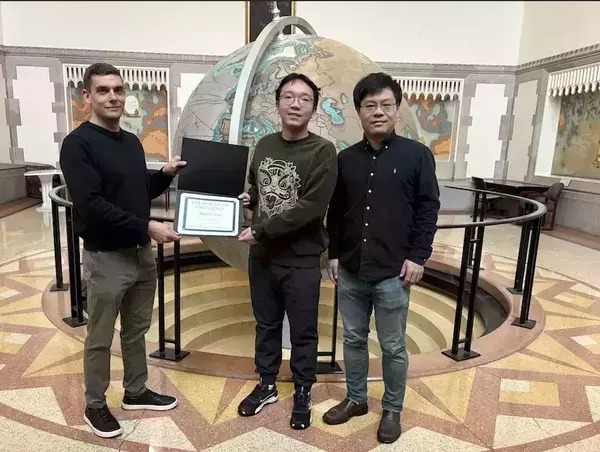
      <![CDATA[<figure class="image image-left"><img src="https://acms.nd.edu/assets/647432/screenshot_2026_02_04_at_94021_am.webp" alt="Prof. Robert Rosenbaum, Director of Graduate Studies, Dailin Gan, Prof. Jun Li." width="300" height="211">
<figcaption><em>Dailin Gan (center) is pictured with his advisor, Professor Jun Li (right), and Director of Graduate Studies, Associate Professor Robert Rosenbaum (left).</em></figcaption>
</figure>
<p>Dailin Gan is the recipient of the 2025/2026 Outstanding PhD Research Award. With his advisor, Professor Jun Li, Dailin is working on research that integrates statistical methodology, machine learning, and computational biology to address fundamental challenges in high-dimensional and single-cell data analysis.</p>
<p>The Outstanding PhD Research Award is awarded to PhD students in their final year of studies who have performed outstanding research during their PhD studies in ACMS.</p>]]>
    </content>
    <link rel="enclosure" type="image/webp" href="https://acms.nd.edu/assets/658928/dailin_gan.webp" title="Dailin Gan"/>
    <author>
      <name>Kathy Phillips</name>
    </author>
  </entry>
  <entry>
    <id>tag:acms.nd.edu,2005:News/178313</id>
    <published>2026-01-08T15:59:00-05:00</published>
    <updated>2026-01-08T16:01:01-05:00</updated>
    <link rel="alternate" type="text/html" href="https://acms.nd.edu/news/xiufan-yu-recognized-as-an-elected-member-of-the-international-statistical-institute/"/>
    <title>Xiufan Yu recognized as an Elected Member of the International Statistical Institute</title>
    <summary type="text">
      <![CDATA[ACMS Assistant Professor, Xiufan Yu, has been selected as an Elected Member of the International Statistical Institute (ISI). The ISI, founded in 1885, is the world-leading international professional…]]>
    </summary>
    <content type="html">
      <![CDATA[<p>ACMS Assistant Professor, Xiufan Yu, has been selected as an <a href="https://isi-web.org/article/congratulations-newly-elected-members-fourth-round-2025">Elected Member of the International Statistical Institute (ISI)</a>. The ISI, founded in 1885, is the world-leading international professional organization dedicated to the advancement of statistical science and serves as a global hub for leading statisticians. The ISI Elected Member is to recognize “individuals who are established in their careers and have made significant contributions to the statistical profession”.</p>
<p>Other Elected Members in ACMS include:</p>
<ul>
<li>Stefano Castruccio, Notre Dame Collegiate Associate Professor</li>
<li>Fang Liu, Notre Dame Collegiate Professor</li>
</ul>]]>
    </content>
    <link rel="enclosure" type="image/jpeg" href="https://acms.nd.edu/assets/642864/profile_yujpg.jpg" title="Xiufan Yu - 2025 photo"/>
    <author>
      <name>Kathy Phillips</name>
    </author>
  </entry>
  <entry>
    <id>tag:acms.nd.edu,2005:News/174977</id>
    <published>2025-09-15T17:01:00-04:00</published>
    <updated>2025-09-16T09:28:09-04:00</updated>
    <link rel="alternate" type="text/html" href="https://acms.nd.edu/news/bringing-math-to-life/"/>
    <title>ACMS Grad Students Bring Math to Life</title>
    <summary type="text">
      <![CDATA[Sreejata Dey (left), SIAM chapter Vice President, Connor Parrow (center) SIAM/AWM chapter President, and Jiabao Nie (right),…]]>
    </summary>
    <content type="html">
      <![CDATA[<figure class="image image-left"><img src="https://acms.nd.edu/assets/630438/300x/sreejata_connor_jiabao.png" alt="Sreejata, Connor, Jiabao - First Fridays" width="300" height="206">
<figcaption>Sreejata Dey (left), SIAM chapter Vice President, Connor Parrow (center) SIAM/AWM chapter President, and Jiabao Nie (right), AWM Chapter Treasurer, guiding a participant through the logic game 'Set'.</figcaption>
</figure>
<p>Members of the SIAM and AWM student chapters joined the College of Science at this year’s Football Friday events, volunteering to lead hands-on activities designed to spark curiosity and engage the community with math and science.</p>
<p>One featured activity, <em data-start="453" data-end="484">The Mathematics of Sunflowers</em>, invited participants to examine the spiral arrangements in sunflower seed patterns. Depending on the counting method used, three distinct numbers emerged—each corresponding to values in the well-known Fibonacci sequence.</p>
<p>Another station showcased interactive simulations from <a data-start="684" data-end="722" rel="noopener" target="_new" class="decorated-link" href="https://visualpde.com">visualpde.com</a>, where visitors explored partial differential equations (PDEs) such as the heat and wave equations in an accessible, visual way.</p>
<figure class="image image-right"><img src="https://acms.nd.edu/assets/630439/300x/hunter.png" alt="Hunter - First Fridays" width="300" height="217">
<figcaption>Hunter La Croix, SIAM Secretary, discussing PDEs with visitors.</figcaption>
</figure>
<p>The popular card game, <em data-start="905" data-end="910">Set</em>, proved to be a fun and challenging way to practice logic and reasoning skills.</p>
<p>These activities brought mathematics beyond the classroom and highlighted how math can be both beautiful and approachable, while strengthening the connection between the University and the broader community.</p>]]>
    </content>
    <link rel="enclosure" type="image/png" href="https://acms.nd.edu/assets/630438/sreejata_connor_jiabao.png" title="Sreejata, Connor, Jiabao - First Fridays"/>
    <author>
      <name>Kathy Phillips</name>
    </author>
  </entry>
  <entry>
    <id>tag:acms.nd.edu,2005:News/172702</id>
    <published>2025-05-19T10:46:00-04:00</published>
    <updated>2025-05-19T10:48:01-04:00</updated>
    <link rel="alternate" type="text/html" href="https://acms.nd.edu/news/huebner-receives-award-for-excellence-in-undergraduate-advising/"/>
    <title>Huebner Receives Award for Excellence in Undergraduate Advising</title>
    <summary type="text">
      <![CDATA[Alan Huebner, Teaching Professor and Director of Undergraduate Studies in ACMS, is the  recipient of the 2025 College of Science Sister Kathleen Cannon Award for Excellence in Undergraduate Advising.  This award at Notre Dame is named in honor of Sister Kathleen…]]>
    </summary>
    <content type="html">
      <![CDATA[<p><a href="https://acms.nd.edu/people/alan-huebner/">Alan Huebner</a>, Teaching Professor and Director of Undergraduate Studies in ACMS, is the  recipient of the 2025 College of Science Sister Kathleen Cannon Award for Excellence in Undergraduate Advising.  This award at Notre Dame is named in honor of Sister Kathleen Cannon, OP, D.Min., a long-time advisor for the Science collegiate sequence majors, and a tireless advocate for students from all backgrounds. Sister Kathleen served as an associate dean of the college of science from 1998 to 2022 and was associate provost of the university from 1990 to 1997.</p>]]>
    </content>
    <link rel="enclosure" type="image/jpeg" href="https://acms.nd.edu/assets/210231/alan_huebner.jpg" title="alan_huebner.jpg"/>
    <author>
      <name>Kathy Phillips</name>
    </author>
  </entry>
  <entry>
    <id>tag:acms.nd.edu,2005:News/171993</id>
    <published>2025-04-28T13:53:00-04:00</published>
    <updated>2025-04-28T13:53:28-04:00</updated>
    <link rel="alternate" type="text/html" href="https://acms.nd.edu/news/rosenbaum-publishes-article-in-nature/"/>
    <title>Rosenbaum and Team Reveal Like-to-Like Wiring Rule in Mouse Visual Cortex</title>
    <summary type="text">
      <![CDATA[Rosenbaum and his collaborators published a new paper in Nature titled “Functional connectomics reveals general wiring rule in mouse visual cortex” (…]]>
    </summary>
    <content type="html">
      <![CDATA[<p>Rosenbaum and his collaborators published a new paper in <strong>Nature</strong> titled “Functional connectomics reveals general wiring rule in mouse visual cortex” (<a href="https://www.nature.com/articles/s41586-025-08840-3" target="_blank" data-saferedirecturl="https://www.google.com/url?q=https://www.nature.com/articles/s41586-025-08840-3&amp;source=gmail&amp;ust=1745945711744000&amp;usg=AOvVaw1qMRdLzCcSx4BcQnOJPB2S" rel="noopener">https://www.nature.com/<wbr>articles/s41586-025-08840-3</wbr></a><a href="https://www.nature.com/articles/s41586-025-08840-3" target="_blank" data-saferedirecturl="https://www.google.com/url?q=https://www.nature.com/articles/s41586-025-08840-3&amp;source=gmail&amp;ust=1745945711744000&amp;usg=AOvVaw1qMRdLzCcSx4BcQnOJPB2S" rel="noopener"></a>). <wbr>In this project, a large team of experimental and computational neuroscientists to understand data generated from the IARPA funded MICrONS (Machine Intelligence from Cortical Networks) program. The MICrONS program generated over one petabyte (one million gigabytes) of data collected from a cubic millimeter of a single mouse brain, containing over 75 thousand neurons and 500 million synapses (neural connections).</wbr></p>
<p>The data set is the first of its kind in which scientists were able to measure both the activity and the connectivity of a large population of neurons. This combination allowed Rosenbaum and his collaborators to study the relationship between neural activity and neural connectivity in a brain at an unprecedented scale. Analysis of the data revealed a like-to-like wiring rule: Neurons that tend to be active at the same time are also more likely to be connected to each other. Rosenbaum helped demonstrate that similar connectivity structures emerge in artificial neural networks trained to recognize images, implying a functional role for the connectivity structures discovered in the mouse brain. The study improves our understanding of the intricate connectivity structure of neurons in the brain, and how it contributes to neural function.</p>]]>
    </content>
    <link rel="enclosure" type="image/jpeg" href="https://acms.nd.edu/assets/140630/robert_rosenbaum.jpg" title="acms_robert_rosenbaum_website.jpg"/>
    <author>
      <name>Kathy Phillips</name>
    </author>
  </entry>
  <entry>
    <id>tag:acms.nd.edu,2005:News/171928</id>
    <published>2025-04-25T13:50:00-04:00</published>
    <updated>2025-04-25T13:50:04-04:00</updated>
    <link rel="alternate" type="text/html" href="https://acms.nd.edu/news/castruccio-named-fellow-of-american-statistical-association/"/>
    <title>Castruccio named Fellow of American Statistical Association</title>
    <summary type="text">
      <![CDATA[Stefano Castruccio, Notre Dame Collegiate Associate Professor in the Department of Applied and Computational Mathematics and Statistics (ACMS), has been named an elected fellow of the American…]]>
    </summary>
    <content type="html">
      <![CDATA[<p><a href="https://acms.nd.edu/people/stefano-castruccio/">Stefano Castruccio</a>, Notre Dame Collegiate Associate Professor in the Department of Applied and Computational Mathematics and Statistics (ACMS), has been named an elected fellow of the <a href="https://www.amstat.org/news-listing/2025/04/21/asa-recognizes-2025-founders-and-fellows">American Statistical Association (ASA).</a></p>
<figure class="image image-right"><img src="https://science.nd.edu/assets/576439/screenshot_2023_11_17_at_21751_pm.png" alt="Stefano Castruccio 2" width="600" height="601"></figure>
<p>He was recognized for using statistical methods to create high-resolution climate simulations for environmental statistics. Castruccio has bridged spatio-temporal statistical models—models that analyze phenomena that vary across both space and time—with machine learning, applying this work to areas from monitoring air pollution to fluid dynamics.</p>
<p>“The ASA fellowship is one of the highest recognitions in the statistical community, and it is very rarely bestowed to an associate professor,” Castruccio said. “It is an important milestone for me as a scholar, but also for growing the reputation and standing of ACMS, my department.”</p>
<p>In 2024, Castruccio and collaborators won the <a href="https://science.nd.edu/news-and-media/news/notre-dame-professor-castruccio-wins-worlds-highest-prize-for-high-performance-computing/">ACM Gordon Bell Prize for Climate Modelling</a>, an honor recognizing outstanding achievements in high-performance climate simulations, which reduce computational costs and data storage seen in typical climate models.</p>
<p>Castruccio earned his bachelor’s degree from Politecnico di Milano in Italy and his doctorate from the University of Chicago. He is the second ASA fellow named from the University of Notre Dame. <a href="https://acms.nd.edu/people/fang-liu/">Fang Liu,</a> acting department chair and Collegiate Professor in ACMS, was honored as a fellow in 2021.</p>
<p>“This award is also an acknowledgment of how Notre Dame has provided me with outstanding support and resources for this achievement,” Castruccio said.</p>
<p>The ASA is the world’s largest community of statisticians, founded in Boston in 1839. It supports development, application, and dissemination of statistical science through meetings, publications, membership services, education, accreditation, and advocacy. Members serve in industry, government, and academia in more than 90 countries, according to the organization’s website.</p>
<p class="attribution">Originally published by <span class="rel-author">Deanna Csomo Ferrell</span> at <span class="rel-source"><a href="https://science.nd.edu/news-and-media/news/castruccio-named-fellow-of-american-statistical-association/">science.nd.edu</a></span> on <span class="rel-pubdate">April 24, 2025</span>.</p>]]>
    </content>
    <link rel="enclosure" type="image/jpeg" href="https://acms.nd.edu/assets/614225/bj_51122_stefano_castruccio_6261jpg.jpg" title="Stefano Castruccio"/>
    <author>
      <name>Deanna Csomo Ferrell</name>
    </author>
  </entry>
  <entry>
    <id>tag:acms.nd.edu,2005:News/171404</id>
    <published>2025-04-04T08:20:00-04:00</published>
    <updated>2025-04-04T08:20:36-04:00</updated>
    <link rel="alternate" type="text/html" href="https://acms.nd.edu/news/kaneb-center-outstanding-graduate-student-teaching-award/"/>
    <title>Steneman recipient of Kaneb Center Outstanding Graduate Student Teaching Award</title>
    <summary type="text">
      <![CDATA[Graduate student Joseph Steneman was awarded the Kaneb Center Outstanding Graduate Student Teaching Award.  This award recognizes graduate student instructors and TAs who demonstrate excellence in the classroom or teaching laboratory.  Awards consist of a certificate from the Kaneb Center and…]]>
    </summary>
    <content type="html">
      <![CDATA[<p>Graduate student Joseph Steneman was awarded the Kaneb Center Outstanding Graduate Student Teaching Award.  This award recognizes graduate student instructors and TAs who demonstrate excellence in the classroom or teaching laboratory. </p>
<p>Awards consist of a certificate from the Kaneb Center and Graduate School, a letter documenting the award for the graduate student’s file, a $100 honorarium, and an invitation to a celebratory dinner.</p>
<p>Past ACMS Award Winners:</p>
<ul>
<li>2024 - Rentian Hu</li>
<li>2023 - Spencer T. Giddens</li>
<li>2022 - Kevin Manley</li>
<li>2021 - Lauren Partin</li>
<li>2020 - Margaret Regan</li>
</ul>]]>
    </content>
    <link rel="enclosure" type="image/jpeg" href="https://acms.nd.edu/assets/589049/joseph_ren_steneman.jpg" title="Joseph (Ren) Steneman"/>
    <author>
      <name>Kathy Phillips</name>
    </author>
  </entry>
  <entry>
    <id>tag:acms.nd.edu,2005:News/170956</id>
    <published>2025-03-24T08:05:38-04:00</published>
    <updated>2025-03-24T08:05:45-04:00</updated>
    <link rel="alternate" type="text/html" href="https://acms.nd.edu/news/major-investments-announced-to-accelerate-research-at-the-intersection-of-bioengineering-and-life-sciences/"/>
    <title>Major investments announced to accelerate research at the intersection of bioengineering and life sciences</title>
    <summary type="text">
      <![CDATA[Notre Dame’s Bioengineering &amp; Life Sciences Initiative has announced significant investments aimed at enhancing and growing biomedical research at the University. These include funding of four new cross-disciplinary faculty research teams and a milestone instrument…]]>
    </summary>
    <content type="html">
      <![CDATA[<p><a href="http://go.nd.edu/BELS">Notre Dame’s Bioengineering &amp; Life Sciences Initiative</a> has announced significant investments aimed at enhancing and growing biomedical research at the University. These include funding of four new cross-disciplinary faculty research teams and a milestone instrument acquisition that will enable cutting-edge experimentation and discovery.</p>
<p>“These exciting commitments have launched large-scale investigations that address timely, wide-ranging health questions and, at the same time, serve as a model for future interdisciplinary growth,” said <a href="https://chemistry.nd.edu/people/paul-bohn/">Paul Bohn</a>, director of the Bioengineering &amp; Life Sciences Initiative, Arthur J. Schmitt Professor of Chemical and Biomolecular Engineering and professor of Chemistry &amp; Biochemistry.</p>
<p>The team projects delve into how the body’s environment affects the growth of cancerous tumors, how biomolecular structures function in the body, how to use AI to track and treat cardiovascular systems, and how to improve cell-based cancer therapies, Bohn explained.</p>
<p>“The acquisition of a cryo-transmission electron microscope, a technology that is one of the most powerful recent developments in biomedical research, is a strong statement about how committed Notre Dame faculty and students are to finding health solutions that serve all people,” he added.</p>
<p>A key priority of the University’s <a href="https://strategicframework.nd.edu/">strategic framework</a>, the Bioengineering &amp; Life Sciences Initiative coordinates and catalyzes multidisciplinary research teams targeting human health and wellness; addresses gaps, needs, and opportunities in expertise and infrastructure; and incentivizes cross-disciplinary collaborations across the university and with external partners. Through strategic investments in research and infrastructure, the initiative brings together specialists from diverse fields to build a powerful environment for productive research.</p>
<h2>New Research Teams</h2>
<figure class="image image-right"><img src="https://strategicframework.nd.edu/assets/607427/mc_21025_bels_group_01jpg.jpg" alt="Five researchers are shown in front of a stairwell" width="600" height="400">
<figcaption>Daniele Schiavazzi, center, is the principal investigator of the CAR.L.L. team. He is pictured here with, from left to right: data scientist Margaret Nichols, undergraduate research assistant Elizabeth Hanley, postdoc Shifu Hou, and doctoral student Grayson Tong. Not pictured: co-PIs Nitesh Chawla and Fang Liu.</figcaption>
</figure>
<p>Each of the four teams awarded Bioengineering &amp; Life Sciences Initiative grants—among the most substantial internal project awards ever distributed at Notre Dame—includes researchers from multiple disciplines. The projects are:</p>
<h3 dir="ltr" role="presentation">CAR.L.L.: An LLM Agent for Physiologic Inversion</h3>
<p dir="ltr" role="presentation">This project is led by <a href="https://acms.nd.edu/people/daniele-schiavazzi/">Daniele Schiavazzi</a>, associate professor in the Department of Applied and Computational Mathematics and Statistics, together with faculty members in the Department of Computer Science and Engineering and colleagues in the Department of Applied and Computational Mathematics and Statistics.</p>
<p dir="ltr" role="presentation">The CAR.L.L. team aims to provide patients and clinicians with a physiological snapshot of the patient’s cardiovascular health by developing a neural network-powered personalized model of each patient’s cardiovascular system. The prototype model will combine anonymized clinical data and data collected from wearable sensors with socio-demographic insights to create cardiovascular “digital twins” to monitor treatment and improve early diagnosis of cardiovascular diseases and abnormalities.</p>
<p dir="ltr" role="presentation"><a href="https://strategicframework.nd.edu/initiatives/health-and-well-being/bioengineering-and-life-sciences-bels/funding-opportunities/collaborative-multidisciplinary-teams/collaborative-multidisciplinary-team-grant-recipients/#CAR.L.L." class="btn">Learn more about the CAR.L.L. team</a></p>
<figure class="image image-left"><img src="https://strategicframework.nd.edu/assets/607433/mc_22125_bels_12jpg.jpg" alt="Four researchers are shown in a Notre Dame lab" width="600" height="400">
<figcaption>The members of the DOME team, from left to right, are: Gabriel Burks, Holly Goodson, Katharine White, Jonathan Whitmer</figcaption>
</figure>
<h3 dir="ltr" role="presentation">Dynamics of Molecular Ensembles (DOME): Multiscale Investigation of Biomolecular Condensates in Biology and Disease</h3>
<p dir="ltr" role="presentation">The DOME team is headed by <a href="https://chemistry.nd.edu/people/katharine-white/">Katharine White</a>, Clare Boothe Luce Assistant Professor in the Department of Chemistry &amp; Biochemistry, along with faculty members in the Department of Chemical and Biomolecular Engineering and colleagues in the Department of Chemistry &amp; Biochemistry.</p>
<p dir="ltr" role="presentation">This team seeks to understand the formation and function of an exciting but understudied class of dynamic biomolecular structures implicated in diseases such as cancer, neurodegeneration, and Type 2 diabetes. Using cutting-edge imaging, structural analyses, computational modeling, and AI-driven data mining approaches, they will study the connections between the “ingredients” of the structures, the “recipes” of their assembly, and their effects on human health and disease.</p>
<p dir="ltr" role="presentation"><a href="https://strategicframework.nd.edu/initiatives/health-and-well-being/bioengineering-and-life-sciences-bels/funding-opportunities/collaborative-multidisciplinary-teams/collaborative-multidisciplinary-team-grant-recipients/#DOME" class="btn">Learn more about the DOME team</a></p>
<figure class="image image-right"><img src="https://strategicframework.nd.edu/assets/607884/bels_impact_team_cropped.jpg" alt="Seven researchers are shown in front of a staircase in various sitting and standing positions." width="600" height="400">
<figcaption>The IMPACT team PIs, from left to right, are: Xin Lu, Tengfei Luo, Sharon Stack, Meenal Datta (head PI), Hsueh-Chia Chang, Matt Webber, Brian Baker</figcaption>
</figure>
<h3>IMPACT: Immunoengineering Microgravity Platform for Accessible Cell-based Therapies</h3>
<p>The IMPACT team is guided by <a href="https://engineering.nd.edu/faculty/meenal-datta/">Meenal Datta</a>, assistant professor in the Department of Aerospace and Mechanical Engineering, along with faculty members in the Department of Chemistry &amp; Biochemistry, the Department of Chemical and Biomolecular Engineering, the Department of Biological Sciences, and colleagues in the Department of Aerospace and Mechanical Engineering.</p>
<p>Cell-based cancer therapies (e.g., CAR-T cells) are drawing significant attention for their promise of improving patient outcomes; however, these therapies are time- and cost-intensive to produce. For these therapies to become more effective, affordable, and rapidly produced, there is a need to understand the conditions required for immune cells to multiply and fight against tumors. By studying the mechanical and gravitational forces on immune cells, this team will uncover what is required to accelerate the engineering of these promising cell types into therapies for rare cancers. A long-term goal of this project is to investigate if and how these promising therapies can be manufactured more inexpensively under microgravity conditions, such as those found in low-Earth orbit. Companies in the space and pharmaceutical industries are already advising the team, some members of which already have active cancer research programs in space</p>
<p><a href="https://strategicframework.nd.edu/initiatives/health-and-well-being/bioengineering-and-life-sciences-bels/funding-opportunities/collaborative-multidisciplinary-teams/collaborative-multidisciplinary-team-grant-recipients/#IMPACT" class="btn">Learn more about the IMPACT team</a></p>
<h3>Uncovering Cancer Matrix Mechano-dynamics as a Druggable Treatment Paradigm</h3>
<figure class="image image-left"><img src="https://strategicframework.nd.edu/assets/607431/mc_21125_bels_14jpg.jpg" alt="Three researchers are shown in a hallway of a Notre Dame building." width="600" height="400">
<figcaption>The Matrix team principal investigators, from left to right, are: Katharine White, Matt Webber, and Donny Hanjaya-Putra</figcaption>
</figure>
<p>Principal investigator <a href="https://engineering.nd.edu/faculty/matthew-webber/">Matt Webber</a>, Keating-Crawford Collegiate Professor of Engineering and associate professor of chemical and biomolecular engineering, leads a team that includes faculty members from the Department of Chemistry &amp; Biochemistry and the Department of Aerospace and Mechanical Engineering.</p>
<p>This cross-disciplinary team aims to engineer new, adaptable materials that allow researchers to better recreate the environment around cancerous tumors in a lab setting. These models will help to predict how changes in the environment around tumors affect disease progression and metastasis, providing an innovative means to test the effectiveness of therapeutic interventions.<strong> </strong></p>
<p><a href="https://strategicframework.nd.edu/initiatives/health-and-well-being/bioengineering-and-life-sciences-bels/funding-opportunities/collaborative-multidisciplinary-teams/collaborative-multidisciplinary-team-grant-recipients/#Matrix" class="btn">Learn more about the Matrix team</a></p>
<h2>New Instrumentation</h2>
<p>In addition to awarding the internal grants, the initiative made a significant investment in a cryo-electron microscope that allows scientists to see the intricate structures of proteins, nucleic acids, and other biomolecules and study how they move and change.<strong> </strong></p>
<p>This investment arose out of a faculty-led survey, conducted by the initiative’s <a href="https://strategicframework.nd.edu/initiatives/health-and-well-being/bioengineering-and-life-sciences-bels/bioengineering-and-life-sciences-infrastructure-committee/">infrastructure committee</a>—chaired by <a href="https://chemistry.nd.edu/people/brian-baker/">Brian Baker</a>, Coleman Professor of Life Sciences in the Department of Chemistry &amp; Biochemistry—that assessed biomedical research needs and capabilities on campus and produced a roadmap for future growth.</p>
<p>“The Glacios 2 instrument, and its related components, represents a significant advance in bio-research capabilities for Notre Dame,” Bohn said. “We’re excited about the discoveries that it will foster and grateful for the efforts Prof. Baker and his committee put into identifying and securing this critical advance.”</p>
<p>“This is just the first of many capability upgrades that the Bioengineering &amp; Life Sciences Initiative aims to bring to scientists and engineers here,” he added.</p>
<p>It is anticipated that the new microscope will be delivered and installed in fall 2025. Work has started to prepare a suitable site and infrastructure to support the instrument, and to recruit a specialist to lead its use and train others.</p>
<p class="attribution">Originally published by <span class="rel-author">Emily Monacelli Guzman</span> at <span class="rel-source"><a href="https://strategicframework.nd.edu/news/major-investments-announced-to-accelerate-research-at-the-intersection-of-bioengineering-and-life-sciences/">strategicframework.nd.edu</a></span> on <span class="rel-pubdate">March 05, 2025</span>.</p>]]>
    </content>
    <link rel="enclosure" type="image/jpeg" href="https://acms.nd.edu/assets/610109/mc_22125_bels_10jpg.jpg" title="A researcher is shown in a Notre Dame lab"/>
    <author>
      <name>Emily Monacelli Guzman</name>
    </author>
  </entry>
  <entry>
    <id>tag:acms.nd.edu,2005:News/168608</id>
    <published>2024-12-03T12:33:00-05:00</published>
    <updated>2024-12-03T12:34:07-05:00</updated>
    <link rel="alternate" type="text/html" href="https://acms.nd.edu/news/notre-dame-professor-castruccio-wins-worlds-highest-prize-for-high-performance-computing/"/>
    <title>Notre Dame Professor Castruccio wins world’s highest prize for high performance computing</title>
    <summary type="text">
      <![CDATA[Stefano Castruccio, Notre Dame Collegiate…]]>
    </summary>
    <content type="html">
      <![CDATA[<figure class="image image-right"><a href="https://acms.nd.edu/people/stefano-castruccio/"><img src="https://science.nd.edu/assets/593374/bj_51122_stefano_castruccio_6261jpg.jpg" alt="Stefano Castruccio" width="600" height="664"></a></figure>
<p><a href="https://acms.nd.edu/people/stefano-castruccio/">Stefano Castruccio</a>, Notre Dame Collegiate Associate Professor, is part of a 12-member team across three continents who won the <a href="https://awards.acm.org/bell-climate">2024 ACM Gordon Bell Prize for Climate Modelling</a>, the highest honor recognizing outstanding achievement in high-performance computing (HPC) applications.</p>
<p>Castruccio is the first researcher from Notre Dame to win the award, which many in the field consider the “Nobel Prize” of HPC applied to real-world systems. The Gordon Bell Prize is in its 37th year, with the prize specifically for climate modelling conferred for the first time in 2023.</p>
<p>Castruccio and his team harnessed the power of some of the world’s most advanced supercomputers to create high-resolution climate simulations, which reduce computational costs and data storage seen in typical climate models. They demonstrated their exascale climate emulator at the International Conference for High Performance Computing, Networking, Storage, and Analysis in Atlanta, where they received their award on Nov. 20, 2024.</p>
<p>Castruccio, a faculty member in the <a href="https://acms.nd.edu/">Department of Applied and Computational Mathematics and Statistics</a> (ACMS) at the University of Notre Dame, led the statistical effort for the research.</p>
<p>“Right now, developing storage is becoming more and more expensive than computation,” Castruccio said. “So at some point, we’re going to run out of space; we are already running out of space for many applications in climate modeling.”</p>
<p>The award is the culmination of 10 years of work, Castruccio said, emphasizing that it involved a diverse and international team of climate scientists, machine learning experts, and high-performance computing specialists.</p>
<p>“This work not only pushes the boundaries of climate modeling technology but also underscores the importance of leveraging cutting-edge computational techniques and high-performance computing infrastructure to unlock new insights into climate dynamics and helps pave the way for a sustainable future for our planet,” said Sudipto Banerjee, senior associate dean for academic programs, University of California-Los Angeles (UCLA) Fielding School of Public Health, as well as professor of the Department of Biostatistics at UCLA.</p>
<figure class="image image-left"><img src="https://science.nd.edu/assets/596236/sc24awards_74.jpeg" alt="2024 ACM Gordon Bell Prize for Climate Modelling award group" width="600" height="389"></figure>
<p>Other team members include <a href="https://awards.acm.org/award-recipients/abdulah_2128838">Sameh Abdulah</a>, <a href="https://awards.acm.org/award-recipients/genton_4887239">Marc G. Genton</a>, <a href="https://awards.acm.org/award-recipients/keyes_7422527">David E. Keyes</a>, <a href="https://awards.acm.org/award-recipients/khalid_0214002">Zubair Khalid</a>, <a href="https://awards.acm.org/award-recipients/ltaief_6242576">Hatem Ltaief</a>, <a href="https://awards.acm.org/award-recipients/song_1757678">Yan Song</a>, <a href="https://awards.acm.org/award-recipients/stenchikov_9993168">Greorgiy L. Stenchikov</a> and <a href="https://awards.acm.org/award-recipients/sun_5033456">Ying Sun</a>, all of King Abdullah University of Science and Technology, Saudi Arabia; <a href="https://awards.acm.org/award-recipients/baker_2904330">Allison H. Baker</a>, of the National Science Foundation’s National Center for Atmospheric Research in Boulder, Colorado; <a href="https://awards.acm.org/award-recipients/bosilica_0403668">George Bosilca</a> of NVIDIA Corp., Santa Clara, California and <a href="https://awards.acm.org/award-recipients/cao_4875628">Qinglei Cao</a> of St. Louis University, St. Louis, Missouri.</p>
<p>“I am thrilled to celebrate this outstanding achievement,” said <a href="https://acms.nd.edu/people/fang-liu/">Fang Liu</a>, interim chair of the Department of Applied and Computational Mathematics and Statistics at Notre Dame. “This collaborative work represents a significant advance in using statistical models with the world's fastest supercomputers to address complex climate change challenges.</p>
<p>At the conference, Castruccio and team members shared an augmented reality visualization of their results using virtual reality glasses. Through the glasses, people could see the two spheres of the earth — the original simulator, and the version with their emulator, for comparison.</p>
<p>“Receiving this prestigious award—the first for Notre Dame faculty—highlights the growing prominence and impact of our department (ACMS) and Notre Dame in computational, statistical, and data science on the international stage,” Liu said.</p>
<p>The following video, demonstrating the visualization, was developed by King Abdullah University of Science and Technology:</p>
<p><iframe width="700" height="393" src="https://www.youtube.com/embed/Ap6krCeCufM" allowfullscreen="allowfullscreen"></iframe></p>
<p class="attribution">Originally published by <span class="rel-author">Deanna Csomo Ferrell</span> at <span class="rel-source"><a href="https://science.nd.edu/news-and-media/news/notre-dame-professor-castruccio-wins-worlds-highest-prize-for-high-performance-computing/">science.nd.edu</a></span> on <span class="rel-pubdate">November 26, 2024</span>.</p>]]>
    </content>
    <link rel="enclosure" type="image/png" href="https://acms.nd.edu/assets/249136/screenshot_2023_11_17_at_2.17.51_pm.png" title="Stefano Castruccio 2"/>
    <author>
      <name>Deanna Csomo Ferrell</name>
    </author>
  </entry>
  <entry>
    <id>tag:acms.nd.edu,2005:News/168369</id>
    <published>2024-11-20T10:50:00-05:00</published>
    <updated>2026-05-13T09:58:55-04:00</updated>
    <link rel="alternate" type="text/html" href="https://acms.nd.edu/news/2024-outstanding-phd-research-award/"/>
    <title>Guoxiang Tong Recipient of 2024.25 Outstanding PhD Research Award</title>
    <summary type="text">
      <![CDATA[Guoxiang (Grayson) Tong (center) is pictured with…]]>
    </summary>
    <content type="html">
      <![CDATA[<figure class="image image-left"><img src="https://acms.nd.edu/assets/595406/300x/2024_outstanding_research_award.png" alt="Prof. Robert Rosenbaum, Director of Graduate Studies, Guoxiang (Grayson) Tong, Prof. Daniele Schiavazzi." width="300" height="211">
<figcaption><em>Guoxiang (Grayson) Tong (center) is pictured with his advisor, Associate Professor Daniele Schiavazzi (right), and Director of Graduate Studies, Associate Professor Robert Rosenbaum (left).</em></figcaption>
</figure>
<p>Guoxiang (Grayson) Tong is the recipient of the inaugural Outstanding PhD Research Award. With his advisor, Associate Professor Daniele Schiavazzi, Grayson is working on data-driven machine learning methods, uncertainty quantification, inverse problems, and identifiability analysis of physics-based models, with a special focus on cardiovascular systems.  </p>
<p>The Outstanding PhD Research Award is awarded to PhD students in their final year of studies who have performed outstanding research during their PhD studies in ACMS.</p>]]>
    </content>
    <link rel="enclosure" type="image/png" href="https://acms.nd.edu/assets/595406/2024_outstanding_research_award.png" title="Prof. Robert Rosenbaum, Director of Graduate Studies, Guoxiang (Grayson) Tong, Prof. Daniele Schiavazzi."/>
    <author>
      <name>Kathy Phillips</name>
    </author>
  </entry>
  <entry>
    <id>tag:acms.nd.edu,2005:News/167278</id>
    <published>2024-10-07T11:09:00-04:00</published>
    <updated>2024-10-07T11:11:29-04:00</updated>
    <link rel="alternate" type="text/html" href="https://acms.nd.edu/news/two-acms-undergraduate-teams-excelled-in-national-undergraduate-statistics-class-project-competition-usclap-coached-by-acms-phd-students/"/>
    <title>ACMS undergraduate teams excel in national Undergraduate Statistics Class Project Competition (USCLAP)</title>
    <summary type="text">
      <![CDATA[Two undergraduate teams from Notre Dame achieved success at the Undergraduate Class Project Competition (USCLAP).  Seung Woo (Alex) Lee and Justin Zych, under the mentorship of Spencer Giddens and Joe Steneman, secured 1st place for their paper on predicting life expectancy using…]]>
    </summary>
    <content type="html">
      <![CDATA[<p>Two undergraduate teams from Notre Dame achieved success at the Undergraduate Class Project Competition (<strong>USCLAP</strong>).  Seung Woo (Alex) Lee and Justin Zych, under the mentorship of Spencer Giddens and Joe Steneman, secured 1st place for their paper on predicting life expectancy using multiple linear regression.</p>
<figure class="image image-left"><img src="https://acms.nd.edu/assets/589047/100x/seung_woo_alex_lee.jpeg" alt="Seung Woo (Alex) Lee" width="100" height="100">
<figcaption>Seung Woo (Alex) Lee</figcaption>
</figure>
<figure class="image image-left"><img src="https://acms.nd.edu/assets/589058/100x/justin_zych.png" alt="Justin Zych" width="100" height="100">
<figcaption>Justin Zych</figcaption>
</figure>
<figure class="image image-left"><img src="https://acms.nd.edu/assets/589051/100x/spencer_giddens.jpg" alt="Spencer Giddens" width="100" height="100">
<figcaption>Spencer Giddens</figcaption>
</figure>
<figure class="image image-left"><img src="https://acms.nd.edu/assets/589049/100x/joseph_ren_steneman.jpg" alt="Joseph (Ren) Steneman" width="100" height="100">
<figcaption>Joseph (Ren) Steneman</figcaption>
</figure>
<p> </p>
<p> </p>
<p> </p>
<p> </p>
<p>Another team, consisting of Ashleigh Jung, Po-Lin (Pauline) Wang, and Alyssa Chin, received Honorable Mention for their analysis on factors leading to extramarital affairs in marriage.</p>
<figure class="image image-left"><img src="https://acms.nd.edu/assets/589052/100x/screenshot_2024_10_07_at_84452_am.png" alt="Ashleigh Jung" width="100" height="100">
<figcaption>Ashleigh Jung</figcaption>
</figure>
<figure class="image image-left"><img src="https://acms.nd.edu/assets/589048/100x/screenshot_2024_10_07_at_90243_am.png" alt="Pauline Wang" width="100" height="100">
<figcaption>Pauline Wang</figcaption>
</figure>
<figure class="image image-left"><img src="https://acms.nd.edu/assets/589050/100x/alyssa_chinjpeg.jpeg" alt="Alyssa Chin" width="100" height="100">
<figcaption>Alyssa Chin</figcaption>
</figure>
<p> </p>
<p> </p>
<p> </p>
<p> </p>
<p>This marks the <a href="https://www.causeweb.org/usproc/usclap/2024/spring/winners">first 1st place win for Notre Dame in USCLAP</a>.  Alex and Justin have been invited to present their work at the Electronic Undergraduate Statistics Research Conference this fall. The competition, sponsored by the American Statistical Association (ASA) and Consortium for Advancement of Undergraduate Statistics Education (CAUSE), attracted entries from college students across the nation.</p>
<p>At Notre Dame, all undergraduate students majoring in ACMS or pursuing it as a supplemental major are required to take the course Statistical Methods and Data Analysis (ACMS 30600). In this course, they complete a significant research project. Each semester, instructors guide around 20 project groups through these rigorous stages, helping students to refine their research and communication skills.  Since the fall of 2021, the ACMS department has had <a href="https://www.causeweb.org/usproc/projects/winners">10 student projects recognized with distinction</a> in this competition.</p>]]>
    </content>
    <author>
      <name>Fang Liu, Vickie Woodard</name>
    </author>
  </entry>
  <entry>
    <id>tag:acms.nd.edu,2005:News/166802</id>
    <published>2024-09-20T15:39:00-04:00</published>
    <updated>2024-09-20T15:42:03-04:00</updated>
    <link rel="alternate" type="text/html" href="https://acms.nd.edu/news/aznaran-wins-cos-postdocs-lightning-talk-competition/"/>
    <title>Aznaran wins CoS Postdocs Lightning Talk Competition</title>
    <summary type="text">
      <![CDATA[Society of Science Postdoctoral Fellow Francis Aznaran won first prize for his talk "Numerical modelling of fluid and solid mechanics" in the Annual CoS Postdoc Lightning Talk Competition. The CoS Postdocs Lightning Talk Competition highlights exciting scientific research being conducted by…]]>
    </summary>
    <content type="html">
      <![CDATA[<p>Society of Science Postdoctoral Fellow Francis Aznaran won first prize for his talk "Numerical modelling of fluid and solid mechanics" in the Annual CoS Postdoc Lightning Talk Competition.</p>
<p>The CoS Postdocs Lightning Talk Competition highlights exciting scientific research being conducted by postdoctoral scholars in the College of Science, and helps develop presentation and research communication skills. The goal is for postdocs to effectively explain their research in three minutes to a non-specialist audience, with the support of a single slide.</p>]]>
    </content>
    <link rel="enclosure" type="image/png" href="https://acms.nd.edu/assets/552867/francis_aznaran.png" title="Francis Aznaran"/>
    <author>
      <name>Kathy Phillips</name>
    </author>
  </entry>
  <entry>
    <id>tag:acms.nd.edu,2005:News/165272</id>
    <published>2024-08-23T09:18:00-04:00</published>
    <updated>2024-08-23T09:41:19-04:00</updated>
    <link rel="alternate" type="text/html" href="https://acms.nd.edu/news/lindsay-appointed-director-of-biophysics-graduate-program/"/>
    <title>Lindsay appointed director of Biophysics Graduate Program</title>
    <summary type="text">
      <![CDATA[The Biophysics Graduate Program, directed by Prof Alan Lindsay, is a cross-departmental doctoral program in the College of Science that trains students at the boundaries between the traditional disciplines of biology, physics, chemistry and ACMS. More information can be found at the website …]]>
    </summary>
    <content type="html">
      <![CDATA[<p>The Biophysics Graduate Program, directed by Prof Alan Lindsay, is a cross-departmental doctoral program in the College of Science that trains students at the boundaries between the traditional disciplines of biology, physics, chemistry and ACMS. More information can be found at the website <a href="http://biophysics.nd.edu/" target="_blank" data-saferedirecturl="https://www.google.com/url?q=http://biophysics.nd.edu/&amp;source=gmail&amp;ust=1724506330574000&amp;usg=AOvVaw1qYkQy_n4U5BlFBxQIw53l" rel="noopener">biophysics.nd.edu</a> and <a href="https://www.instagram.com/biophysnd/" target="_blank" data-saferedirecturl="https://www.google.com/url?q=https://www.instagram.com/biophysnd/&amp;source=gmail&amp;ust=1724506330574000&amp;usg=AOvVaw2ejKdQCLc19dcgLgXTl0I3" rel="noopener"><wbr>instagram</wbr></a>.</p>
<p>Please get in touch if you have any questions or want to get involved with the program! </p>]]>
    </content>
    <link rel="enclosure" type="image/jpeg" href="https://acms.nd.edu/assets/112747/alan_lindsay.jpg" title="alan2013_3.jpg"/>
    <author>
      <name>Kathy Phillips</name>
    </author>
  </entry>
  <entry>
    <id>tag:acms.nd.edu,2005:News/165070</id>
    <published>2024-08-14T09:05:00-04:00</published>
    <updated>2024-08-14T09:16:47-04:00</updated>
    <link rel="alternate" type="text/html" href="https://acms.nd.edu/news/claire-bowen-acms-phd18-elected-american-statistical-association-asa-fellow/"/>
    <title>Claire Bowen (ACMS PhD'18) elected American Statistical Association (ASA) Fellow </title>
    <summary type="text">
      <![CDATA[Claire Bowen, ACMS (PhD'18) was elected as an American Statistical Association (ASA) Fellow in 2024 "For her significant contributions in the…]]>
    </summary>
    <content type="html">
      <![CDATA[<figure class="image image-right"><img src="https://acms.nd.edu/assets/578286/300x/screenshot_2024_08_14_at_91515_am.png" alt="Claire Bowen" width="300" height="285"></figure>
<p>Claire Bowen, ACMS (PhD'18) was elected as an American Statistical Association (ASA) Fellow in 2024 "For her significant contributions in the field of statistical data privacy, leadership activities in support of the profession, and commitment to mentoring the next generation of statisticians and data scientists."</p>
<p>Bowen is the first alumni from ACMS to be elected as an ASA fellow, a prestigious recognition and the fellow designation limited to one-third of 1% of membership each year. At Notre Dame, Bowen worked with Professor Fang Liu on her doctoral thesis titled "Data Privacy via Integration of Differential Privacy and Data Synthesis"</p>
<p>Bowen is currently a senior fellow and leads the Data Governance and Privacy Practice Area at the Urban Institute. Her research focuses on developing technical and policy solutions that aim to safely expand access to confidential data for advancing evidence-based policy-making. She also has interests in improving science communication and integrating data equity into the data privacy process. Further, she is a member of the Census Scientific Advisory Committee and several other data governance and data privacy committees as well as an adjunct professor at Stonehill College.</p>]]>
    </content>
    <link rel="enclosure" type="image/png" href="https://acms.nd.edu/assets/578286/screenshot_2024_08_14_at_91515_am.png" title="Claire Bowen"/>
    <author>
      <name>Kathy Phillips</name>
    </author>
  </entry>
</feed>